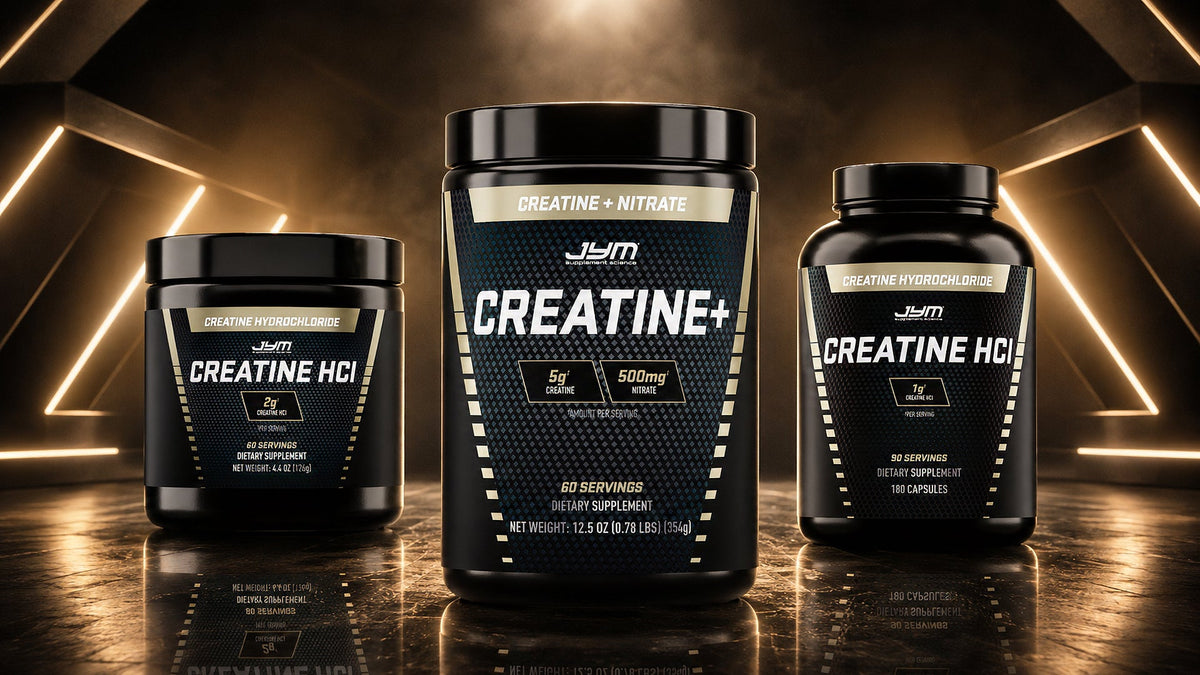
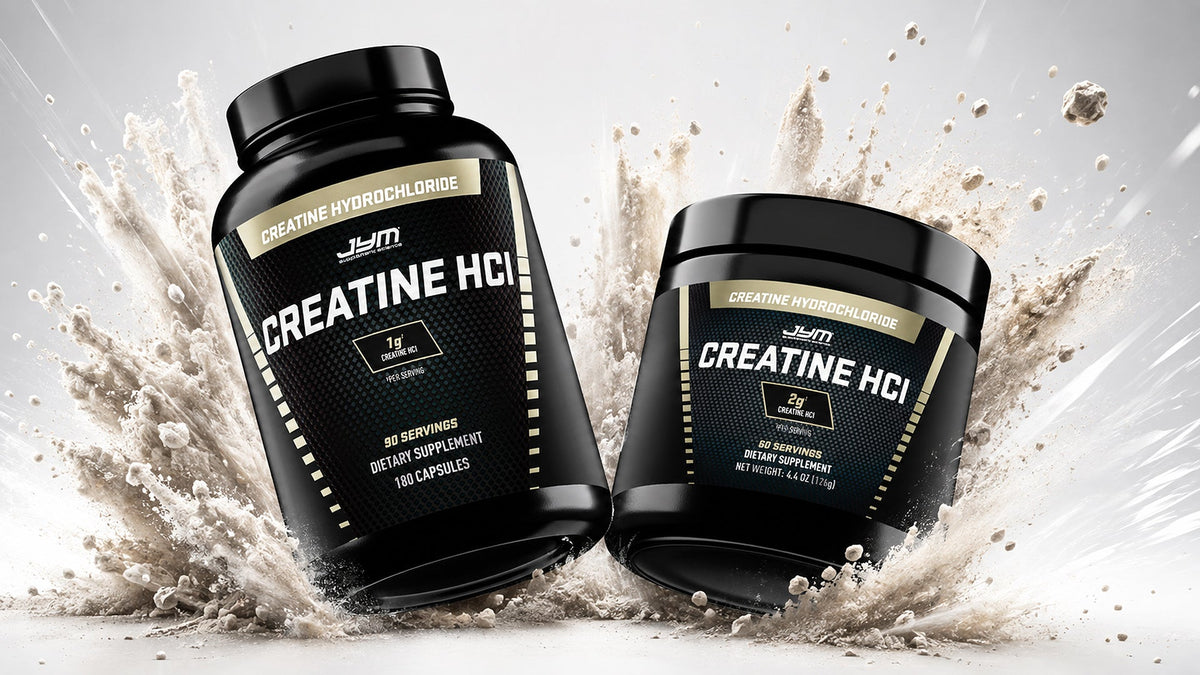
The highly soluble form of creatine used in several JYM formulas is now available in standalone powder and capsule forms.
Creatine HCl has been part of the JYM Supplement Science system from the beginning. I chose it for my pre- and post-workout formulas because it mixes easily, requires a smaller serving, and may be easier to tolerate than creatine monohydrate.
Until now, however, getting creatine HCl from JYM meant taking it as part of a complete pre- or post-workout formula. My new JYM Creatine HCl product changes that. Available in both powder and capsules, it provides a standalone way to use HCl on rest days, add it to an existing supplement stack, or take it without the other ingredients in a pre- or post-workout formula.
Why Creatine HCl?
As I explained in my Creatine HCl vs. Creatine Monohydrate article, HCl doesn’t perform a different job once it reaches your muscles. Both forms ultimately deliver creatine. The difference is how that creatine is delivered.
Binding creatine to hydrochloride (HCl) creates a salt that dissolves far more readily in water. In one laboratory analysis, creatine HCl was approximately 38 times more soluble than monohydrate at room temperature. In practical terms, that means less grit in your shaker and little or no undissolved powder collecting at the bottom.
Greater solubility doesn’t mean creatine HCl has been proven to build more strength or muscle than monohydrate. In fact, a recent head-to-head study found no significant differences between the two forms in the performance or body-composition measures studied. HCl’s advantages are more practical: It mixes easily, can be delivered in a smaller serving, and may be a better option for people who have trouble digesting monohydrate.
I’m one of those people. As I recently told Gary Brecka on The Ultimate Human Podcast, a standard 5-gram serving of creatine monohydrate doesn’t agree with my stomach, so HCl is the form I use personally. Larger single servings of creatine are more likely to cause GI problems; one study found that taking 10 grams at once increased the incidence of diarrhea compared with dividing the same amount into two servings. No thanks!
If monohydrate works well for you, there’s no reason to abandon it. But if digestive discomfort or gritty mixing keeps you from taking creatine consistently, creatine HCl gives you another option.
How Much Creatine HCl Should You Take?
I’ve traditionally used 2 grams of creatine HCl per serving in JYM formulas, with 2 grams before training and another 2 grams afterward. That remains a strong foundation, but I’m increasingly looking at 5 grams of total creatine per day as a starting point—not the ceiling.
Three to five grams is enough to support muscle creatine stores for many people. But creatine also fuels the brain and other tissues, and getting more creatine into the brain may require a higher intake. As I explained to Gary, that could mean moving closer to 10 grams per day. Depending on your body size, diet, and goals, a daily total of 10 grams or more may make sense.
That doesn’t mean taking it all at once. Divide higher daily totals into multiple servings, and count every form of creatine you use. You don’t need a loading phase; the goal is to reach your daily target consistently, including on rest days.
Where JYM Creatine HCl Fits
The JYM product lineup now gives you several ways to build your total daily creatine intake. Pre JYM, Pre JYM Stim-Free, and Post JYM BCAAs+ Recovery Matrix each provide 2 grams of HCl. Pre JYM Plus supplies 5 grams of creatine monohydrate, while JYM Creatine+ combines 4 grams of monohydrate with 1 gram of creatine nitrate.
Rather than viewing these as either-or options, look at how they contribute to your daily total. Pre JYM plus Post JYM, for example, supplies 4 grams of HCl around your workout. Standalone JYM Creatine HCl can help you build toward a higher target in smaller increments—without relying on one large serving—and makes daily dosing easier on rest days or whenever you aren’t using your regular workout formulas.
Powder or Capsules?
The active ingredient is the same, so this is a convenience decision—not a results decision.
Choose the powder if you already make a daily shake or workout drink and want to mix HCl into it. Each scoop delivers 2 grams of creatine HCl—the same serving I’ve used in JYM formulas from the start—and because it’s unflavored with no other ingredients, it disappears into whatever you’re already drinking: water, a protein shake, or your pre- or post-workout formula.
Choose the capsules if you want a premeasured option that requires no mixing and travels easily. Each capsule provides 500 milligrams of creatine HCl, and a serving of two capsules delivers 1 gram. That smaller increment lets you fine-tune your intake in half-gram steps—take four capsules to match the 2-gram serving in Pre JYM or Post JYM, add a couple on rest days, or spread your daily total across the day—without opening a tub or eyeballing a scoop.
Neither format works better. Pick the one you’re most likely to take consistently.
JYM Creatine HCl at a Glance
| Powder | Capsules | |
|---|---|---|
| Creatine HCl per serving | 2 g | 1 g (500 mg per capsule) |
| Serving size | 1 scoop | 2 capsules |
| Servings per container | 60 | 90 (180 capsules) |
| Flavor | Unflavored | — |
| Other ingredients | None | Capsule and flow agents only |
| Suggested use | 1 scoop twice a day, with or without food | 2 capsules twice a day, with or without food |
Those are the label directions. Adjust your total daily creatine intake based on your body size, diet, and goals, and count the creatine in any other JYM products you use.
A More Flexible Way to Take Creatine
Creatine HCl isn’t new to JYM. What’s new is the ability to get it by itself, in whichever format works best for your routine.
If you want a highly soluble form of creatine, prefer a smaller serving, or don’t tolerate monohydrate well, JYM Creatine HCl gives you a simple way to take the form I’ve trusted—and used myself—for years.
References
Gufford BT, Sriraghavan K, Miller NJ, Miller DW, Gu X, Vennerstrom JL, Robinson DH. Physicochemical Characterization of Creatine N-Methylguanidinium Salts. Journal of Dietary Supplements. 2010;7(3):240–252.
Londoño-Velásquez D, Zuluaga-Narváez Y, Rojas-Posada L, et al. Creatine Monohydrate Versus Creatine Hydrochloride on Strength and Body Composition in Elite Team-Sport Athletes: A Placebo-Controlled Randomized Clinical Trial Comparing Low Dosages. Journal of the International Society of Sports Nutrition. 2025;22(sup1):2533658.
Ostojic SM, Ahmetovic Z. Gastrointestinal Distress After Creatine Supplementation in Athletes: Are Side Effects Dose Dependent?. Research in Sports Medicine. 2008;16(1):15–22.