Creatine faceoff: Both forms support strength, power, and muscle growth. Here’s how their differences in dosing, solubility, and tolerability can help you choose.
Creatine has been helping people build muscle and strength since long before half the supplements in your cabinet had names. It works, it’s affordable, and it has been studied more extensively than just about any other performance ingredient.
The debate isn’t whether you should take creatine. It’s which form you should take.
Creatine monohydrate is the traditional choice and the form used in the vast majority of research. Creatine hydrochloride, better known as creatine HCl, offers the same foundational benefits in a more soluble form that requires a smaller serving and may be easier on your stomach.
Both forms of creatine work, plain and simple. The real difference is how much you need, how well you tolerate it, and what else you want your creatine to do.
How Creatine Improves Performance
Creatine helps your body rapidly regenerate adenosine triphosphate, or ATP, the primary energy source your muscles use during intense exercise. Once creatine enters muscle cells, it’s converted into phosphocreatine, which helps replenish ATP. Think of phosphocreatine as your muscles’ rapid-response energy reserve.
More available ATP can help you maintain high-intensity effort longer, whether you’re grinding through a heavy set of squats or bench press, chasing another rep on arm day, or trying to sustain your power late in a HIIT cardio workout. Over time, that added training volume can contribute to greater gains in strength and muscle and even an increase in calorie- and fat-burning. One extra rep may not look like much, but stack enough of them across weeks and months and your body notices.
Creatine also pulls water into muscle cells, supporting cellular hydration and creating an environment that can help promote muscle growth. Its potential benefits extend beyond muscle, with research suggesting that creatine can also support memory, cognition, and brain energy, among many other potential perks.
The form you take doesn’t change creatine’s basic job. But monohydrate and HCl behave differently before the creatine ever reaches your muscles.
Creatine Monohydrate: The Proven Standard
Creatine monohydrate has the deepest research résumé of any form of creatine. Decades of studies show that it can improve strength, power, training capacity, and lean muscle gains when taken consistently.
It’s also widely available and relatively inexpensive. That’s a hard combination to argue with. For someone who digests it well, monohydrate remains a proven and highly effective option.
The standard daily amount is generally 3–5 grams, although I have long recommended getting at least 4–5 grams per day. A loading phase can help saturate the muscles faster, but it isn’t required. Consistent daily use will gradually bring your muscles to full saturation.
The potential downside is that monohydrate doesn’t always dissolve well. For some people, undissolved creatine can contribute to cramping, diarrhea, or general stomach discomfort. Some users also report feeling bloated or holding unwanted water outside the muscle cells.
Plenty of people take monohydrate without experiencing any of these issues. But if your shaker cup has a layer of creatine at the bottom—or your stomach reminds you every time you take it—HCl may be a better fit.
Creatine HCl: The More Soluble Option
Creatine HCl is made by attaching a hydrochloride group to creatine. This lowers its pH and dramatically increases its solubility in fluid.
Laboratory data have found creatine HCl to be roughly 40 times more soluble than monohydrate. In supplement terms, that isn’t a rounding error—it’s a completely different mixing experience. HCl’s greater solubility may also improve oral bioavailability, although direct human absorption research remains limited.
You can see the solubility difference when you mix it. Creatine HCl dissolves almost immediately instead of leaving a pile of sediment at the bottom of the glass, water bottle, or shaker cup. That greater solubility also allows you to get an effective amount from a smaller serving, potentially reducing digestive problems and unwanted water retention.
That’s a major reason I personally use and recommend creatine HCl. Creatine monohydrate has never agreed with my stomach. With HCl, I get the creatine benefits I want without the gastrointestinal issues I don’t.
Does Creatine HCl Work Better?
This is where the argument often gets ahead of the science.
Published studies directly comparing the performance benefits of creatine HCl and monohydrate remain limited. We don’t have enough head-to-head research to definitively say that HCl builds more muscle or strength.
What we do know is that HCl provides creatine in a far more soluble form. My own data and experience with trained lifters suggest that it can produce excellent gains in strength, power, lean muscle, and training endurance. I’ve also heard from thousands of people who had a much better experience after switching from monohydrate to HCl.
Creatine monohydrate absolutely works. That’s never been in question (at least by people who know what they’re talking about). But HCl may provide comparable creatine benefits from a smaller serving while being easier to mix and tolerate. For many people, those practical advantages matter.
How Much Creatine Should You Take?
For creatine monohydrate, 5 grams per day remains a reliable starting point. With creatine HCl, I recommend 2 grams per serving. On training days, my long-standing approach has been 2 grams before training and another 2 grams afterward.
That doesn’t mean 5 grams is a hard daily ceiling for creatine. The conversation around higher creatine intakes is evolving, and larger daily amounts (10 grams and even up to 20) may offer additional benefits in certain situations. That’s a topic I’ll cover in greater detail separately.
For now, the important point is that your ideal intake depends on the form you use, the other supplements in your routine, and your individual goals. More isn’t automatically better, but 5 grams shouldn’t automatically be treated as the most anyone could ever need.
Consistency still matters most. Creatine supplementation works by keeping creatine stores in the muscles elevated, so it should be taken daily—including rest days—not just on training days.
How Creatine Fits Into the JYM System
Before adding a standalone creatine product, look at how much creatine you’re already getting from your pre- and post-workout supplements. For example:
- Pre JYM provides 2 grams of creatine HCl.
- Pre JYM Plus provides 5 grams of creatine monohydrate.
- Pre JYM Stim-Free provides 2 grams of creatine HCl.
- Post JYM BCAAs+ Recovery Matrix provides 2 grams of creatine HCl.
If you use Pre JYM or Pre JYM Stim-Free before training and Post JYM afterward, you’re getting 4 grams of creatine HCl across the workout window. If you use Pre JYM Plus, you’re getting 5 grams of monohydrate before you even start training.
Then there are standalone creatine products, which provide more flexibility. A product that contains only creatine allows you to take the ingredient on rest days, use it when you don’t need a complete pre- or post-workout formula, or build a creatine routine around the form and ingredients you prefer.
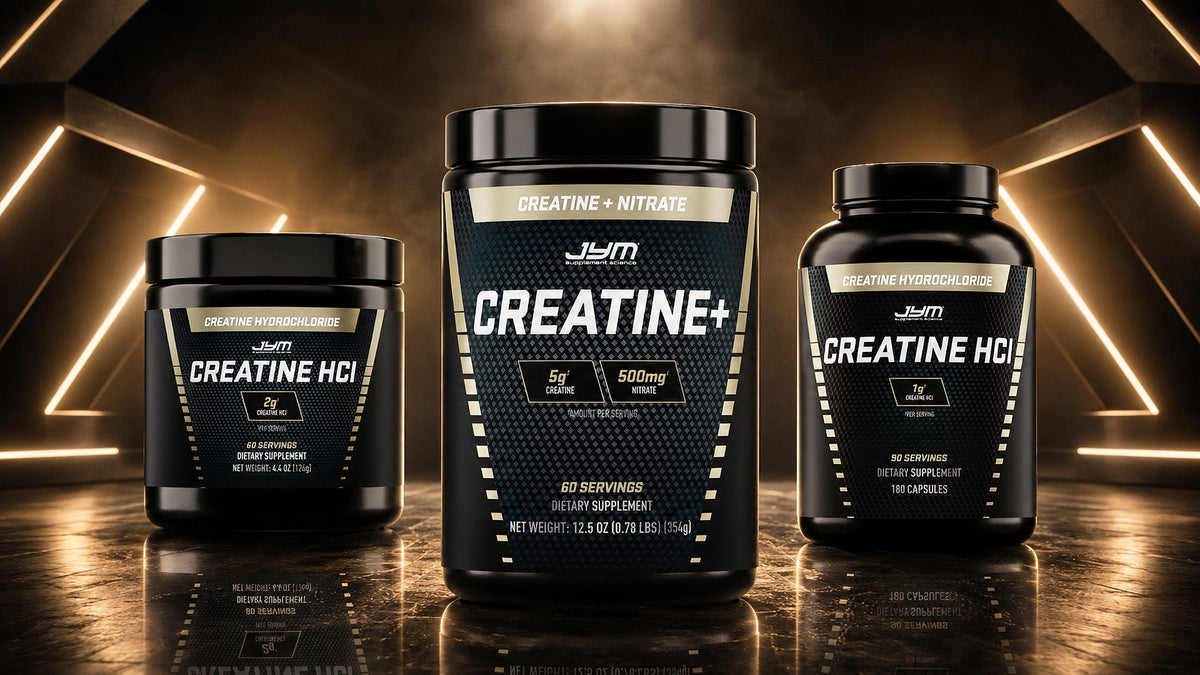
I now offer two standalone creatine options. The first, JYM Creatine+, provides 5 grams of total creatine from two sources: 4 grams of creatine monohydrate and 1 gram of NO3-T® creatine nitrate. Creatine nitrate also delivers 500 milligrams of dietary nitrates to support nitric oxide production, blood flow, muscle pumps, and training endurance.
That combination supports performance from two directions: Creatine helps replenish ATP inside the muscle, while nitrates support the blood flow and oxygen delivery that help keep it working. If you prefer HCl, you can pair it with dietary nitrates for similar complementary support. Just remember that creatine nitrate also contributes to your total creatine intake.
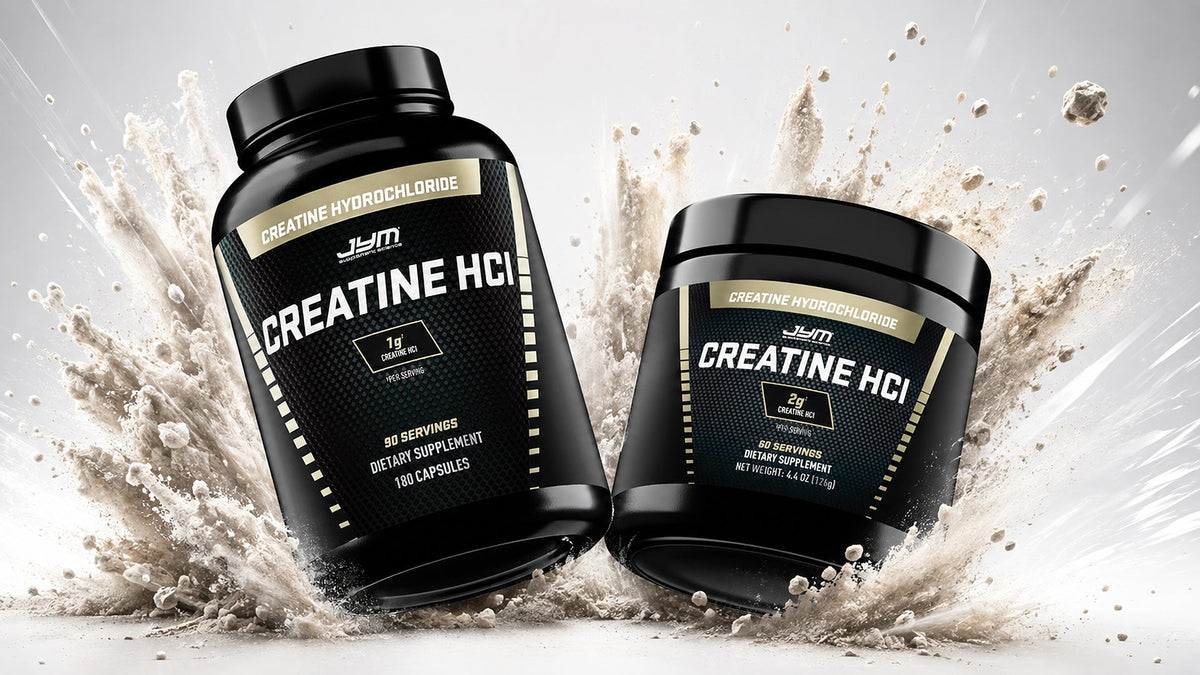
The second is JYM Creatine HCl, which gives people who prefer that form an easy way to use it daily—including on rest days—without needing to take an entire pre- or post-workout formula. JYM Creatine HCl Powder provides 2 grams per scoop, and JYM Creatine HCl Capsules provide 500 milligrams per capsule, so you can match the 2-gram serving in Pre JYM or Post JYM or fine-tune your intake in half-gram steps.
Which Form of Creatine Should You Choose?
The right creatine choice depends on how you want it to fit into your routine—built into a pre- or post-workout formula or taken on its own. Here’s where each JYM option fits.
- Choose JYM Creatine+ if you want a straight-up creatine monohydrate formula. Yes, there’s also creatine nitrate in it, but for all intents and purposes, this is the choice for monohydrate fans.
- Choose Pre JYM Plus if you prefer creatine monohydrate but want your full 5-gram dose built into a comprehensive pre-workout formula that includes BCAAs, beta-alanine, betaine, and other high-performance ingredients.
- Choose creatine HCl if monohydrate bothers your stomach, you want something that dissolves more easily, or you prefer getting your creatine from a smaller serving. You can get creatine HCl from Pre JYM or Pre JYM Stim-Free before training, Post JYM BCAAs+ Recovery Matrix afterward, or my standalone JYM Creatine HCl, in powder or capsules, whenever you want HCl without a complete pre- or post-workout formula.
The best choice is the one that fits your goals, agrees with your stomach, and works consistently within your supplement routine.
References
Alraddadi EA, Lillico R, Vennerstrom JL, Lakowski TM, Miller DW. Absolute Oral Bioavailability of Creatine Monohydrate in Rats: Debunking a Myth. Pharmaceutics. 2018;10(1):31.
Antonio J, Ciccone V. The Effects of Pre Versus Post Workout Supplementation of Creatine Monohydrate on Body Composition and Strength. Journal of the International Society of Sports Nutrition. 2013;10:36.
Eghbali E, Arazi H, Suzuki K. Supplementing With Which Form of Creatine (Hydrochloride or Monohydrate) Alongside Resistance Training Can Have More Impacts on Anabolic/Catabolic Hormones, Strength and Body Composition?. Physiological Research. 2024;73(5):739–753.
Galvan E, Walker DK, Simbo SY, et al. Acute and Chronic Safety and Efficacy of Dose-Dependent Creatine Nitrate Supplementation and Exercise Performance. Journal of the International Society of Sports Nutrition. 2016;13:12.
Gufford BT, Sriraghavan K, Miller NJ, Miller DW, Gu X, Vennerstrom JL. Physicochemical Characterization of Creatine N-Methylguanidinium Salts. Journal of Dietary Supplements. 2010;7(3):240–252.
Hultman E, Söderlund K, Timmons JA, Cederblad G, Greenhaff PL. Muscle Creatine Loading in Men. Journal of Applied Physiology. 1996;81(1):232–237.
Kreider RB, Kalman DS, Antonio J, et al. International Society of Sports Nutrition Position Stand: Safety and Efficacy of Creatine Supplementation in Exercise, Sport, and Medicine. Journal of the International Society of Sports Nutrition. 2017;14:18.
Larsen FJ, Weitzberg E, Lundberg JO, Ekblom B. Effects of Dietary Nitrate on Oxygen Cost During Exercise. Acta Physiologica. 2007;191(1):59–66.
Volek JS, Duncan ND, Mazzetti SA, et al. Performance and Muscle Fiber Adaptations to Creatine Supplementation and Heavy Resistance Training. Medicine & Science in Sports & Exercise. 1999;31(8):1147–1156.
Xu C, Bi S, Zhang W, Luo L. The Effects of Creatine Supplementation on Cognitive Function in Adults: A Systematic Review and Meta-Analysis. Frontiers in Nutrition. 2024;11:1424972.